With growing adoption of ServiceNow, more organizations are investing both in the platform to drive transformation and in partners that extend the value of that investment. Today, the ServiceNow Partner Program includes more than 2,700 partners, some with industry-specific specializations and others with product-focused expertise.
To make it easier for organizations to find the right partner, ServiceNow has designated partnership levels that correspond to varying degrees of support and engagement. Each level provides different benefits and reflects a different tier of expertise.
Choosing the right partner isn’t as simple as selecting a name from a list. You first need to understand the ServiceNow partner program and credentialing system, as well as how to assess and compare different partner profiles. Then, you need to factor in your goals, desired outcomes, and long-term business strategy to find the perfect fit.
Here’s a quick guide for getting started.
The ServiceNow partner program
Based on partners’ skill sets and experience levels, ServiceNow’s partnership tiers are designed to help customers quickly understand the depth and breadth a partner can bring: across workflows, industries, geographies, and size of business served.
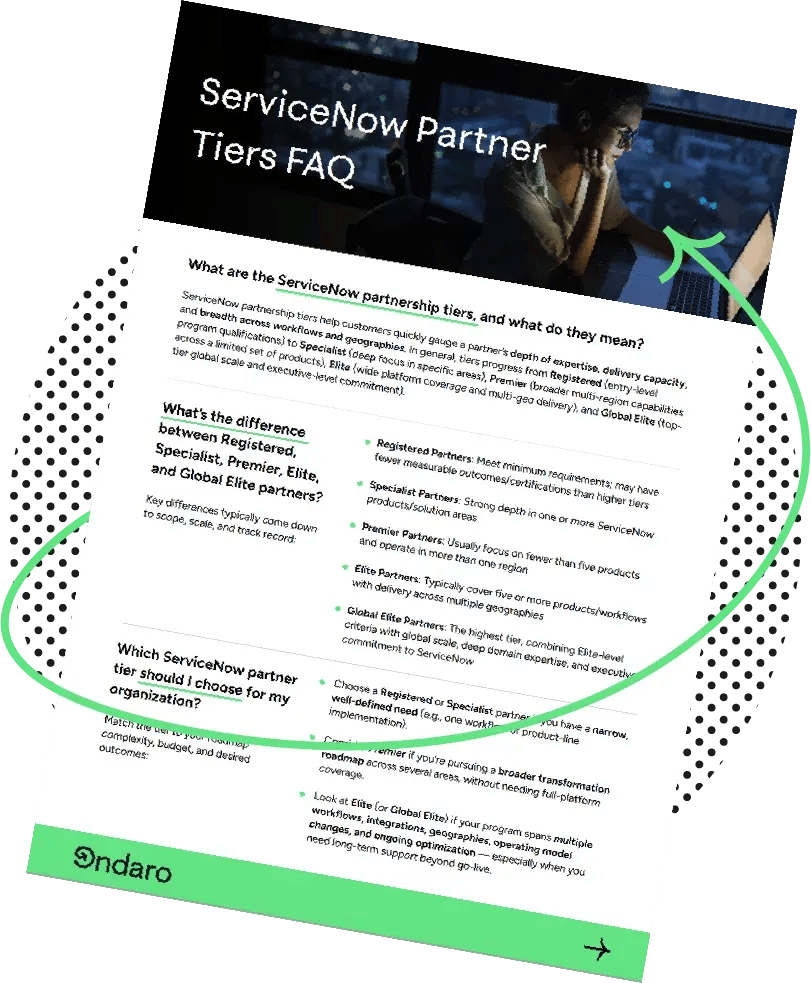
Here’s a brief overview of what you can expect from each ServiceNow partnership level (noting that ServiceNow evaluates partners using criteria commonly framed as capacity, competency, customer success, and capability).
- Registered Partners: New to the ServiceNow partner ecosystem. They’ve met minimum program qualifications but may not yet have extensive measurable activity or certifications.
- Specialist Partners: Provide highly specialized skills in one or more ServiceNow products or solution areas.
- Premier Partners: Focus on fewer than five ServiceNow products and have established operations in more than one geographic region.
- Elite Partners: Specialize in five or more ServiceNow products/workflows and have operations across multiple geographies.
- Global Elite Partners: Global Elite partners meet Elite criteria and operate at a global scale with executive‑level commitment to their ServiceNow practice. There are only six partners with this designation: Accenture, Deloitte, EY, KPMG, Infosys, and Cognizant.
It’s important to know the key differences between the tiers so you can make informed decisions about which type of partner is best suited to your budgets, needs, and goals.
Benefits of each ServiceNow partnership level
The expertise and specialties of each partner can vary greatly. From Registered Partners that are just starting out to Elite Partners that bring a wealth of experience, each level can bring value, depending on what you’re trying to achieve with your ServiceNow investment.
Here are some of the specific benefits of each level of partnership:
- Registered Partners can provide basic support and services, but they may have less depth across the platform than higher tiers.
- Ideal for: Smaller-scale investments and specific product-line implementations; may be a fit for organizations with tighter budgets or lower operational demands
- Specialist Partners can provide deep expertise in a particular area of ServiceNow
- Ideal for: Organizations looking to tackle targeted objectives or challenges
- Premier Partners can offer a wider range of services across several areas, supporting a broader transformation roadmap without necessarily spanning the full platform.
- Ideal for: Organizations ready to invest in more comprehensive digital transformation
- Elite Partners have a stronger track record of delivery across more workflows, often across multiple geographies
- Ideal for: Organizations needing end-to-end support and deep subject matter expertise for complex, enterprise-scale program implementations
- Global Elite Partners have the resources and scale to support transformation globally, with mature governance, change leadership, and large‑program execution capabilities.
- Ideal for: Organizations seeking enterprise-level digital transformation on a global scale
When choosing a ServiceNow partner, consider their level of expertise and competency as well as their specialties within the platform. A partner with a specialized focus in your area of need can bring additional value and insight to your end-to-end roadmap.
For larger, more complex implementations, a few important points still hold true:
- A Specialist Partner may be ideal when your need is narrow and deep (e.g., one product line, one domain).
- Premier and Elite Partners tend to be better suited when your roadmap spans multiple workflows, geographies, integrations, operating models, and ongoing optimization —because the work is rarely “one-and-done” once you add automation and AI into the mix.
In addition, higher-tiered partners often have teams with a wider range of skills and experience. This allows them to provide more comprehensive solutions tailored specifically to your needs. They often offer ongoing, post-implementation services, including operations and enhancements;filling in the ServiceNow resource gaps that many organizations have.
How to compare different ServiceNow partners
When selecting a ServiceNow partner, it’s important to consider how the partnership will align with your business goals.
Here are some additional elements to consider when comparing ServiceNow partners:
Size and scale of the partner organization: A partner’s size and scale can impact their ability to handle complex projects, provide dedicated support, and manage client relationships — not to mention pricing. Ask for pricing and delivery model details when vetting a partner.
Industry experience: Partners with experience in your industry can bring valuable domain knowledge and patterns, which can lead to a more efficient implementation process. Looking at case studies and hearing from reference clients can help validate this.
Geographical presence: Depending on your organization’s needs, it may be important to consider geographical presence and ability to provide local support. ServiceNow’s partner listings and profiles can help clarify regional coverage.
Technical certifications and expertise: Partners can hold different certifications and specializations that indicate expertise across specific areas of the platform. In today’s environment, it’s also reasonable to ask how a partner approaches AI enablement, including:
- Data readiness and governance (so AI outputs are grounded and reliable)
- Workflow design (so agents/automation have clear boundaries and escalation paths)
- Security and oversight (so humans remain appropriately in the loop)
Customer reviews and references: Research customer reviews and speak with references to understand reliability and delivery approach. This is especially crucial for large programs where outcomes, expertise and timeline need to be vetted well beyond slideware.
Specific sectors: ServiceNow organizes its ecosystem across multiple partner segments (e.g., Consulting & Implementation, Service Provider, Reseller), and many partners operate across more than one segment. Consider which engagement model best fits your needs before you compare tiers.
Consider your long-term strategy
When choosing a ServiceNow partner, it’s important to consider not only your immediate needs but also your long‑term strategy. This includes a partner’s ability to support growth and scalability, their investment in ServiceNow, and their commitment to staying current with platform advancements — particularly as ServiceNow continually expands their workflow capabilities, industry-specific solutions and embraces use of AI agents and agentic orchestration across the enterprise.
A successful partnership goes beyond selecting the right provider. To make the most out of the partnership:
- Establish clear goals and expectations
- Maintain open, regular communication
- Stay current with platform releases and roadmap changes
- Invest in training, certification, and adoption support
When you have the know‑how to navigate the partner program, compare partners, understand the benefits of each tier, and align the partner to your long‑term strategy, you can select a ServiceNow partner that helps you find success — now and as AI capabilities mature.