
Platform Owner MasterClass: Building a Business Case for Investment, Buy-In, and Growth
This session gives ServiceNow Platform Owners a practical framework for building business cases that get approved, so you can unlock investment, align stakeholders, and move your roadmap forward.
Transcript
Christine Morris: Just a quick introduction. I am Christine Morris. I am a Senior Director here at Ondaro and I lead our consulting services group. I've been in the ServiceNow ecosystem — I guess it's about 11 years at this point. About half that time was as a customer for a global manufacturer, where I was responsible for platform ownership. Ron, you want to introduce yourself?
Ron Burt: Sure. I'm Ron Burt, 27 years in a higher ed institute within their IT department, started nine years ago in ServiceNow back in Kingston. And I was kicking and screaming, dragged into ServiceNow. Couldn't stand it at first, but once I got into ServiceNow and started seeing all the relationships and everything, I just love it. I eat, sleep and breathe ServiceNow. Been with Ondaro for a little while as an ITSM Associate Director. I love the creative minds and the great people, like Christine, that I get to work with on a daily basis. Nice to meet everybody. Looking forward to this session.
Christine Morris: Thanks, Ron.
Ron Burt: Yep.
Christine Morris: Today we're going to do a quick intro, a couple of slides about Ondaro, and then we're going to talk about some of the platform owner challenges — building the business case, finding the right support for your business case, and how we fight those objections. We've all heard the nasty word "no."
I want to highlight what Ondaro brings to the table. We have deep expertise across the ServiceNow platform. Our practices are led by seasoned functional leaders who were once practitioners themselves. We understand the challenges that you face firsthand. You can see on the left all of the practice expertise that we have. We're a little different from some of the other partners. We don't really do generalists. We believe that the platform has become so broad and so wide that it's important for us to understand in great detail and have that expertise around all the areas we operate in. We really operate in these three key pillars. Under Envision, things like business transformation, organizational change management, AI readiness — everybody's favorite word these days — focused on things like platform strategy and governance.
Implement and Develop — we've got some amazing platform architecture folks, engineers, product implementation, UI/UX designers. We've got a large program for application development. And then we also provide some steady state. We know that sometimes you've got to call on some outside assistance. For many of our customers, we serve as their development team, maintaining the platform.
A little housekeeping. We want this to be interactive. You can come off mute if you want to add feedback or ask a question. You can enter questions in the chat. If many of you have been on our MasterClass sessions, you know we love polls, and we'll ask you to respond to some polls as we go through this. We love reactions. If you need closed captions, click on "More" and you can find "Show Captions" for the session.
Before we start, if you haven't had a chance to check out some of our other MasterClass series, I would encourage you to do that. We'll post a link in the chat. We've done ten sessions on CMDB — you can never talk about CMDB enough. It's one of our most attended sessions, and then also around our IT Asset Management practice as well. Lots of good content on best practices — not necessarily driven to try to sell you more, but to help you understand best practices around these areas. Check it out in your free time.
I want to start with a statement that I've heard from platform owners across almost every industry: "I know we need more resources, but I can't get the approval." The challenge usually isn't that leaders don't recognize the platform is important. The challenge is translating platform needs into a business case that resonates with people who control budgets, headcount, and priorities.
That's really what today's session is all about. One of the most important insights I've learned over the years is that building the business case is often more valuable than the approval itself. The process forces alignment. It helps stakeholders understand demand, your capacity constraints, business risk, and the impact of underinvestment — before you've even made the ask.
And sometimes that process leads to a different answer than you expect. The right first step might not be a new hire. It could be governance improvements, better prioritization, automation, partner support, process changes that free up capacity. Today we'll walk through a practical framework that you can use to justify your next investment — whether it's an FTE, whether it's bringing in staff aug, whether it's a partner project engagement. By the end of the session, we really want you to be able to write a business case that you can start using today, and then finally find the right support and know how to handle those objections.
A lot of platform owners are technically right about the need, but the business case still gets rejected because the message is not landing with leadership the way that you need it to. We want to walk through some of the most common failure points that we see. The first is speaking the wrong language.
Many platform owners naturally explain problems through a technical lens — ticket volume, backlog, modules, integrations, technical debt, upgrade complexity. But executive stakeholders are speaking a whole different language, and they're evaluating through a business lens. They're looking at things like cost, risk, productivity, operational impact, employee or customer experience. Instead of saying "we need another developer because the backlog is growing," you might try something like: "We are currently delaying onboarding automation enhancements that impact employee productivity and create manual HR effort every quarter."
Same problem, just completely different framing. The second issue is leading with what you need instead of why it matters. If the very first sentence is "we need another admin," many leaders mentally move into budget defense mode immediately. Instead, you want to start with the operational story. What is happening? What is the impact? What risk is increasing? What outcomes are being delayed? And then introduce the recommendation.
The third issue is failing to quantify the cost of inaction. A surprising number of business cases only explain the desired future state and never explain the consequences of doing nothing. Without that urgency, leadership often defaults to "not now." You need to clearly articulate what slows down, what risks increase, what manual effort continues, what business outcomes are delayed, what employee or customer frustration remains. Even directional estimates are often enough to strengthen credibility.
And finally — this is a big one that a lot of organizations overlook — sometimes asking for a full-time employee is actually the hardest path to approval. FTE approvals are slow, they can be political, they can be tied to broader financial planning cycles. A small partner engagement or targeted advisory effort is sometimes a much easier "yes" — faster procurement, lower long-term commitment, immediate action. And often it helps you prove the value needed to later justify that permanent headcount. For many organizations, partners become the bridge that helps build the internal case for future investment.
Strong business cases are not just technically accurate. They are aligned to executive priorities, operational outcomes, and organizational realities. Fundamentally, it's storytelling.
Our first poll — we'd love you to respond. What's your biggest capacity constraint right now? A: your backlog keeps growing faster than you can handle. B: strategic projects keep getting delayed. C: too much reactive work, not enough innovation. Or D: all of the above. Put your answers in the chat and let's take a look. I suspect we'll have lots of D's.
Let's look at that — they're rolling in. Kudos. John's got A and C. Nice. Another D. The D's have it. We knew that would be the case. It's always nice to know we're all suffering together.
Let's continue. Let's talk about building the business case.
One of the biggest mistakes platform owners make is creating a single generic pitch for every stakeholder. You really need to know your audience. Different executives care about very different outcomes. If we look at the Chief Financial Officer perspective, they're usually evaluating financial impact, efficiency, risk exposure, and time to value. They're not typically focused on platform features or technical elegance. Language like "we need better CMDB health" may not resonate.
But if you say something like "we are spending hundreds of manual hours reconciling inaccurate asset and configuration data, which increases operational cost and audit risk" — oh, audit risk, cost — that really gets their attention much faster.
Finance leaders want to understand what a problem costs today, what savings or cost avoidance exists, and how quickly the investment pays back. If we compare that to the CIO audience — CIOs are usually thinking about scalability, platform maturity, delivery velocity, technical debt, standardization, and long-term roadmap execution that's going to bring outcomes to the business.
The conversation really shifts from pure cost into operational sustainability and strategic enablement. If you say "we cannot continue supporting 40 custom workflows without impacting upgrade timelines and delivery speed" — that's a platform maturity conversation, not just a staffing conversation. And then we've got our HR operations leaders. This audience often responds most strongly to employee experience or customer experience, operational friction, manual work, service consistency, and process automation. For them, the story is about the human impact — delayed onboarding, frustrated employees, frustrated customers, inconsistent service delivery, managers wasting time on manual coordination.
The same initiative can be framed completely differently depending on who is listening. And I really want to emphasize this: find your internal champions. Ron's going to talk a lot about that in the next section. In many organizations, the most successful platform owners are not operating alone. They have executive sponsorship from someone who already believes in the value of the platform and is willing to advocate when decisions happen behind closed doors — rooms that you are not going to be in. A strong internal champion helps carry the message into budget reviews, leadership discussions, prioritization meetings, and strategic planning sessions.
Before writing a single word of your business case, ask yourself: Who is my audience? What outcomes matter to them? And who can help amplify this message internally? That preparation often matters more than the document itself.
Let's talk about quantifying the problem.
This is really where the conversation starts to become much more credible with leadership. Most executives will listen to pain points, but numbers and real data create a sense of urgency. One of the biggest differences between a weak business case and a strong one is the ability to quantify operational impact in business terms.
I want to stress this — your numbers don't need to be perfect to be effective. Many platform owners hesitate because they think they need finance-grade precision before presenting a case. In reality, directional data that clearly demonstrates impact is often enough to move that conversation forward.
Let's look at a few examples. A growing backlog is not just a workload problem — it's delayed value delivery. If your backlog is increasing 30% year over year, that means the business is demanding more from the platform than the team can realistically support. And we all know that happens. You end up in a situation where there are things you never touch on your backlog. When I was a platform owner, I had things in my backlog from three years before — half the people that asked for it don't even work at the company anymore.
And eventually that creates prioritization fatigue, stakeholder frustration, and slower innovation. The second metric here is delayed strategic projects. This is one of the most powerful areas to quantify because executives understand delayed outcomes. If important initiatives are consistently slipping by six months or more, the platform team lacks capacity. The business impact compounds quickly — delayed automation savings, delayed operational efficiencies, delayed employee improvements, delayed compliance or risk initiatives. And we know those can cost money. The cost of those delays far exceeds the cost of the additional support being requested.
But they don't understand that. The third example is deferred automation value. A lot of organizations underestimate the hidden cost of manual work that continues simply because no one has time to automate it — manual approvals, spreadsheet tracking, email coordination, offline workarounds. When you annualize that effort across teams, the numbers can become surprisingly compelling. The lower section of the slide is the practical takeaway.
How do I actually calculate this in my organization? A few places to start: look at your backlog growth trends, measure average project delays, review ticket aging and reopen rates, identify the manual work that should already be automated, and estimate the hours spent outside of the platform in spreadsheets and email workflows.
If you're using ServiceNow Performance Analytics or some of the reporting dashboards, you likely have a lot of the data needed to begin building the story.
One additional thing I want to call out is shadow IT. This becomes increasingly important as platform teams become overloaded. When official processes move too slowly, the business finds a way — whether it's approved or not. They build things like Access databases, or even worse, they go get rogue SaaS tools that aren't approved for use. These result in security risk, compliance risk, data quality issues, and operational inconsistency. That hidden cost is absolutely part of the business case.
Don't just describe the challenge — quantify how staffing gaps affect operations, service delivery, and overall business outcomes.
Let's talk about the business case framework.
We want to simplify this as much as possible, and we really find that it falls into four clear components. First, define the problem clearly and very specifically — avoid vague statements like "we need more help." Instead, explain the operational gap in measurable terms: growing backlog, delayed projects, missed automation opportunities, rising support demand as more people get onto the platform, or increasing technical debt. The more concrete the problem statement is, the more credible the conversation becomes.
Next, explain the business impact. This is where you connect the operational issue to the organizational outcomes. Things like delayed savings, compliance and audit risks, employee or customer frustration, slower delivery, increased manual work, reduced scalability. This step is critical because executives fund business impact, not platform pain.
Then define the solution approach. For many organizations, a phased or partner-led approach is often the most practical starting point because it lowers approval risk and accelerates time to value. The key is positioning the solution as a business accelerator, not simply additional support.
Finally — and maybe the most challenging — quantify the ROI. Show the math wherever possible. Cost avoidance: if we automate X, we can save 200 hours a month. Automation savings, reduced manual effort, faster delivery, reduction of ticket volume, operational efficiency gains. Even directional estimates are often enough to strengthen the case. The overall goal is creating a business story that is specific, quantifiable, business-focused, and easy for leadership to understand quickly.
Let's dive into our poll. If you suddenly received budget for one thing, what would you choose? A: additional admin or developer. B: a business analyst or process owner. C: automation or AI tooling. D: training or upskilling.
Tyler says he would like an additional admin or developer. John says automation and AI tooling — which is a good one for the business case piece. Lots of AI folks.
I love the B's because commonly not having that business analyst is a big gap. I think we talked a lot about the business analyst role in our last session. Not having the business analyst is a big gap between explaining things in technical terms and getting it to the business. Business analysts are accustomed to writing these types of business cases.
I'm going to turn it over to Ron to talk about finding the right support.
Ron Burt: Thank you, Christine. Denied, denied, denied. That is a word that everybody does not like to hear. But unfortunately it's a word that I've heard a lot in my time as a platform owner. And I can only assume that the majority of you have also heard it as well. We had an aggressive roadmap, as Christine was mentioning. We had a single instance of ServiceNow, but several different departments within the higher ed environment that we were managing, and everybody had their own priorities. We were growing this backlog and we kept submitting to our CIO — asking to hire another FTE. We went through everything that Christine said not to do.
We went with the very first big ask: "We just need another FTE." And unfortunately, every other unit was also asking for more. We kept getting denied. We needed to figure out another way to make our asks stand out. As you'll see, there are several challenges that many platform owners face where internal advocacy alone has its limits.
Competing priorities, budgetary pressures, organizational politics — especially in higher ed — or simple leadership fatigue when they're hearing the same concerns repeatedly. That's kind of what we were facing. We changed the ask. Instead of asking for that full FTE, we asked for funding to do a third-party platform assessment. That's really that first box on the left. What that is, is an independent review that provides more objective visibility into things like platform health, utilization, process bottlenecks, governance gaps, technical debt that could pose issues down the road, and resource constraints.
But it also helped to answer a very important executive question: compared to similar organizations, are we actually underinvested? That benchmarking element is incredibly valuable because leadership teams often like having an external perspective before approving any type of investment. It's good to have that from an outside source — not just internal people saying we're overworked.
Assessments can also help identify quick wins. Sometimes organizations assume they need major staffing increases, but the assessment reveals opportunities for improvement in areas like intake governance, better workflow design, platform standards, clarification around roles and responsibilities, and reporting visibility. Sometimes it's just getting the right reporting that can spotlight issues and, boom, that can solve a lot of things by just highlighting the data. Or taking some of those automations — where things can be done in an automated fashion — and prioritizing some of those.
And that credibility is what matters. That's how a platform assessment can provide insight into that world. The second thing is the value-aligned roadmap. The roadmap shifts that conversation from "we need help" to "here is a phased, measurable plan that's tied to business outcomes." It's much easier to have a conversation that executives can support when a roadmap shows what initiatives should happen first, why those initiatives matter, what resources are required, and what value is expected. And ultimately, how success is going to be measured. By defining all of those, it helps create prioritization alignment across leadership teams — which is often one of the biggest challenges you as a platform owner will face. Making sure you're aligned in your prioritization across all the teams so everyone is rowing in the same direction.
The third point — why does third-party engagement work so effectively? First, as I mentioned, it removes some of that internal politics from the conversation. You get outside of your internal bubble and get some outside perspective. Outside assessments can often say things that platform owners have been saying for years internally, but it's just noise. When somebody comes in from the outside, it can help validate those things — yes, those are true issues and true concerns.
Second, executive leaders often trust comparative market data and outside benchmarks because they provide context beyond what they might perceive as internal opinions. "I feel our team is overworked" — but being able to either validate that or bring in outside insight from a third-party perspective carries a lot more weight.
And third, bringing in a partner can obviously accelerate action. You're not tying up internal resources — you have outside resources coming in. It's usually easier to approve a targeted assessment or a short-term engagement than a permanent headcount. In our case, instead of pushing for an FTE, we explored small, short-term engagements with a partner. What that allowed us to do was move faster, reduce risk — if it doesn't work, it doesn't work, and there's not this big FTE investment on the line. But on the flip side, if it does work, you start to see some of the benefits, build momentum, and you now have an evidence-based justification you can build on for future investment decisions. That's why it can help to start with a small engagement and then build on that success.
One thing I always encourage platform owners to remember: you don't have to solve every challenge alone before asking for help. Sometimes the smartest move is to bring in the right expertise to help you quantify those gaps, align leadership, and create a realistic path forward.
Christine Morris: Fundamentally, if you bring in somebody to do the assessment, they are going to say the same things you've already said. You know you've been talking to a brick wall — and then all of a sudden they really start to listen. That's been the biggest game changer. And having a roadmap that's aligned to business outcomes — aligned to the goals of the organization — that's a big game changer as well. Because now you're truly speaking their language. You're aligning things to goals and outcomes.
Ron Burt: And as we all know in big organizations, strong ideas rarely move forward on individual merit alone. They move forward when the right leaders understand the impact and advocate for them. Christine mentioned this earlier about finding champions. A champion can carry a message into rooms you may never get to enter — budget planning meetings, executive prioritization sessions, high-level roadmap discussions, leadership review sessions. And often those conversations are where approval decisions are actually made.
Getting that strong champion to advocate for you is going to help remove some of that organizational friction and get your message across in those settings. Every platform owner has experienced conflicting priorities — departments competing for funding, governance slowing down decisions, or platform work getting deprioritized against other initiatives.
An executive sponsor can help cut through that noise and reinforce why this investment matters strategically. And when you can identify those pain points and align them to a goal the organization is trying to achieve, that helps connect the request to broader business goals. Here are some examples of what leadership is often focused on: employee retention, operational efficiency, AI readiness, digital transformation, compliance — where some folks are forced into action — and cost optimization. If that's what the leadership is focused on, a champion can come in and position the platform investment as an enabler of those priorities.
And then it becomes more than just an IT request — it's tied to those priorities. And more importantly, this is going to help you in the long run: you're going to sustain buy-in after approval. Because getting the funding is really only step one, that's really the start.
Long-term success is going to require that continued executive support as priorities evolve and the roadmap develops. But if you can show the benefit, show the growth, the opportunities of addressing those pain points, those small wins can ultimately build on to bigger wins. And you build more confidence for future things that you're going to be doing.
The big question then becomes: how do you actually identify the right champion? A good starting point is to look for leaders who are already publicly recognizing platform value — what ServiceNow brings to the organization. Those folks who've had some automation successes, have some insight into the reporting, have seen some employee experience improvements or operational efficiencies, or any ServiceNow metrics that are being surfaced in leadership conversations. Folks who are already seeing wins and showing metrics to others — those are the signals that they understand ServiceNow's strategic importance in the organization. They'll be more likely to want more of that and to champion it.
Another strong indicator is accountability pressure. Who owns initiatives that are currently being slowed down by platform capacity constraints? Who is experiencing those pain points? Those leaders are often highly motivated allies because your problem is directly impacting their outcomes. Pay attention to executives who are escalating about delivery times, bottlenecks, or delays. Escalations can be uncomfortable in the moment, but they reveal where business pain is highest and where support for investment could exist to help address those issues.
And finally, one of the biggest mistakes people make — front and center — is approaching executives with the ask too early. Don't start with "I need more headcount" or "I need more FTEs." Build the case. Paint the picture. Start with: here's the business challenge we're seeing, here's the operational impact, here's what's at risk if nothing changes. We might look fine on the surface, but we're burning our people out and there are issues behind the scenes. Paint the picture and then collaborate on a solution together. It's better if someone feels like they're part of the solution, rather than being hit with a cold ask at the onset. People support what they help to shape, and people support what they feel they're a part of — brought along the journey, not blindsided with an ask.
Any questions on finding champions?
We'll go to the next one. Champions are great to help you — and making the ROI tangible is one of our biggest challenges. How do we make the return on investment feel real instead of a theoretical exercise? Leadership teams are constantly hearing requests. "We need more admins, more developers, more architects, more budget." With all of those asks, what's going to separate a successful request from a rejected one is the ability to reduce perceived risk.
We're going to make a plug here for partner engagement, because it is often easier to approve. It's more controlled — there's a defined scope, a defined timeline, defined outcomes. It's time-bound. It gives leadership confidence that the organization can test the investment — kind of like a proof of concept — before making a larger long-term commitment.
And it can create momentum quickly. Instead of spending months waiting on hiring approvals and recruiting cycles, you can start addressing and solving problems immediately. Automating some of that manual work, reducing the backlog, actually prioritizing and reducing it, improving governance, accelerating delivery, and addressing operational pain points. Those are quick wins.
And those quick wins matter because they create evidence. Once you have that evidence, it becomes incredibly valuable when you're requesting permanent headcount later. You have data-informed decisions, a track record to go back with. A full-time hire is usually evaluated differently because it's seen as a long-term financial obligation. The scrutiny is higher: Is this need sustainable? Are the values measurable? Will they reduce cost or increase efficiency long term? Is the platform mature enough to absorb additional staff efficiently?
That's why you need to think about sequencing strategically. Sometimes the smartest path is using a targeted engagement to create measurable improvements, capture those outcomes and operational metrics — key point right there. Part of Lean Six Sigma and the DMAIC model is you define a problem and you measure it. First step: measure where you're at. Then you can report on the benefit you've had after implementing improvements. Now you're talking real data, not just theoretical. Capture those outcomes, capture those metrics, then use those results to justify the permanent investment.
That's going to dramatically change the conversation when you can say: we reduced our manual effort by X hours, we automated these workflows which reduced this, we reduced ticket volume from X to Y, we accelerated delivery times, we addressed these pain points, and we avoided this operational cost.
When you can put metrics in front of people to help them make a decision, it's no longer a hypothetical return — leadership is truly evaluating proven results. Executives will trust demonstrated value more than projected value. Anybody can estimate future savings on a spreadsheet — it looks great. But what really gets attention is actuals: actual improvements, actual efficiency gains, actual reduction in business friction. That's what's going to create confidence.
For example, on the slide there — a real-life example: a partner engagement at $65K will deliver three automations that save $85K a year. That proof can fund a full FTE with a clear payback story. There's no leap of faith. This is what it can do — and when you're building confidence to hire that FTE, you have the data to back it up. That confidence is what's going to unlock any future investment.
If not, we have a poll for you.
Christine Morris: When you've tried to make a business case in the past — if you have — what usually happens? A: it gets stuck in "we'll revisit this next quarter or next budget year." B: I can't clearly show an ROI. C: leadership agrees but doesn't approve. D: I haven't tried yet — that's why I'm here.
Two B's. Hopefully you've learned some tools and tricks today to help you down that path.
If you're interested in an assessment, one of the things we can do is give recommendations aligned to those business outcomes — with percentages. And the other side of it is that it does vary. There are certain aspects of the platform — like SAM Pro — that will pay for itself consistently across the board. Whereas if you're asking for Now Assist, some of that value might be more visible on the back end — in the way that you work or the way that you communicate — not as visible to the rest of the organization. So it can be tricky.
Ron Burt: For those who went with A — getting stuck and revisiting next quarter — we experienced that as well. Food for thought: look at addressing the "what happens if we don't do this" question. Make sure that's in front of them as well. You can keep kicking the can, but at some point there's a cliff and that can's going to go over it. A lot of times people just kick it to the next quarter and get stuck.
Christine Morris: Telling the cost of inaction is important. And Mark says we are getting closer and closer to that cliff. Sometimes it feels like you're standing on the edge of it and everybody's getting ready to push you off.
Our next section — we're going to talk about fighting objections.
Handling objections is one of the most important skills a platform owner can develop. Because resistance does not automatically mean the answer is no. Very often, objections are signals — budget anxiety, risk concerns, timing concerns, or a lack of confidence in the value story. The mistake many people make is becoming defensive when objections happen.
And I get it. You're in the trenches, you're asking too much of your team, you constantly feel buried, you can never get ahead of your backlog. And you're thinking: why won't you help me? It's very easy to be defensive. But instead, start thinking about objections as part of the business conversation from the beginning.
You've likely asked for things before and been told no for a specific reason. Go into this business case knowing the exact objections they'll have and the answers to those objections. A common response platform owners hear is "we need to do more with less." Rather than arguing against it, acknowledge it and shift the conversation toward operational reality. You could say something like: "I agree, efficiency matters. But here's where we are already seeing the impact of that reduced capacity." And then bring the data. We can't say enough about the data — the growing backlog, the delayed initiatives, the deferred automation, the increased manual work, missing delivery targets. You've got not just enhancements to make — you've got to maintain the platform, administer your groups, and do all those other things. The goal is not emotional escalation. It's hard, because you watch your team struggle. But the goal is helping leadership understand the measurable costs of underinvestment.
Another very common response is "we cannot approve another FTE right now." That does not necessarily mean the organization disagrees with the need. Sometimes it just means timing is bad, budget cycles are frozen — and honestly, the economy is in a tough spot right now. When I was in the customer world, it seemed like the IT budget was always the first one to get cut or frozen. Headcount is politically difficult. Leadership wants more evidence first. And this is where flexibility matters. Instead of treating the conversation as all-in or nothing, pivot toward lower-risk options — scoped partner support, assessments, or even temporary staff aug. Bring someone in to knock out some of those big wins that let you show the outcomes the business is looking for. That keeps the momentum moving while also building measurable proof points for a future staffing request.
You may also hear "let's revisit this next budget cycle." Don't treat that as a dead end. Tie that request back to already-funded strategic initiatives like AI readiness, employee experience, or operational efficiency. Fundamentally, executives — almost every executive except for the person at the very top — has someone they answer to. They want to look good. They want to look like they're supporting the organization and that those goals matter to them. That's why it's so important to tie these requests to strategic initiatives. Position the conversation around business risk and delivery impact: "We can absolutely revisit staffing later, but without additional support, we should align on which strategic initiatives may slow down or get deferred."
That changes the tone from "they just want more people" to "here are the business trade-offs we need to make together." One of the most effective strategies is understanding that partner engagements and FTE requests are often connected, not competing. A smaller engagement can become the operational proof that later supports the permanent investment, like we talked about before.
The best responses to objections are calm, data-driven, collaborative, and business-focused. The goal is not winning an argument — as much as we all might like to. The goal is building alignment around operational reality and those business priorities.
Now let's assume we've got everything documented — we're ready. We've pulled in our champions, we've got data, metrics, and ROI.
One of the biggest mistakes people make is waiting until the formal presentation to introduce the business case for the first time. By the time you're in an official approval meeting, opinions are already forming — or already formed. Strong leaders start to socialize the message before the presentation ever happens. The presentation itself should rarely be the first conversation. It should be the final confirmation of alignment that has already been building behind the scenes with your champions and your own leadership.
A great starting point is your frontline users and operational stakeholders. These are the people experiencing the delays, the manual work, the backlog pain, the process friction, inconsistent service delivery. Their feedback gives credibility to your story because it demonstrates that the challenge is not isolated to IT concerns. It also helps you uncover examples and operational pain points that resonate strongly with leadership.
Next, meet individually with your key decision makers and investment stakeholders before the formal review. This is incredibly important because it allows you to understand objections early, identify areas of concern, learn which metrics matter most to each leader, and refine your message before that high-stakes meeting. These conversations are often where the real work happens. If someone has concerns, you want to hear them privately first — not in front of a whole panel of people, not at your architecture review board.
Another important step is simplifying and refining the story. One of the best tests: can someone clearly understand the business value in 30 seconds? If the case feels too technical, has too much technical jargon, it's too complex. It's overloaded with platform terminology. Executives are going to struggle to connect it to actual business impact. Focus on operational outcomes, risk reduction, efficiencies, delivery acceleration, employee and customer experience. Money talks.
A clear and concise message always wins over an overly detailed one. And then finally, once you get the approval, shift immediately into execution. A common mistake is to continue selling after the decision has already been made. Instead, focus on delivering quick wins. Communicate progress — I can't say that enough, and I think it's one of the things that platform teams probably do the least. You're constantly pumping out workflows, introducing new modules, solving business problems. But IT doesn't do the best job of marketing what we do. Start blasting that out to the world. Show them those measurable outcomes, show them the value you're providing to the organization. Every successful initiative builds credibility for the next investment conversation.
If you tackle this and kill it — save the company hundreds of thousands of dollars — the next time you come to them with a business case, they're actually going to listen a lot more than they would if you just said "I need more bodies to do the work." Future approvals become much easier when they see that consistent pattern of execution.
Any questions on this?
When we were meeting internally, I was like, we can't just tell them all these things — we must show them a realistic example of a business case. So we did put this together to show you how the pieces fall together. What you see on the right is a one-sheet business case — kind of like a worksheet — to start putting your thoughts into play, which we're going to share with you at the conclusion of the session.
You can see we clearly called out the problem: 4,200 managed endpoints, no authoritative software asset inventory — buying and buying with no clue what you have. $2.1 million in unplanned audit spend over 18 months — that's a big one. $800,000 in open audit exposure. Finance froze renewals until visibility is established. This is a big, costly problem. You can see we've quantified it — we have dollars.
The solution for this specific example was a 12-week partner implementation. They did discovery, reclaim workflows, and audit readiness — without an FTE. Partner-owned delivery from day one. And then the ROI: they saved $380K. That's why it's so important — like Ron talked about — to define how you're going to measure it, because you want to go back and validate it. Often as platform owners, we're a little scared to put what we think the real numbers are out there. We'll say "based on my calculations it's $600K" and then cut it to $400K because we don't want to be wrong. Quite often the ROI is actually higher than what you've estimated.
For this one, the audit exposure was mitigated. Fundamentally, the project paid for itself in six months. It was a $185K investment that fundamentally saved millions of dollars over the course of several years.
From an objection handling standpoint, no headcount approval was needed to start. The Microsoft true-up was in Q2, and that delay had a dollar cost. You can see on the sheet — it's a bit of an eye chart — but some of the things we were already addressing from an objection standpoint.
One more poll. What's your next step after today's session? A: I'm going to start building my business case. B: I'm going to start gathering data to quantify my problem. C: talk to some potential internal champions. D: explore partner support to accelerate.
John says A — he's going to start building his business case. I love it. Beth says she's going to start working on her champions. Mo's like, I'm going to do it all.
The champions are huge. From my own experience, IT was always the last to get money. But if you're getting money that supports an HR case or a customer case, those people have more clout in the organization and they can help you.
The project manager in me has an action plan for you. This week: start pulling the data — backlog data, delivery data. List your top three projects blocked by capacity issues. Identify who approves resources or funding in your organization. And then identify your internal champions.
Over the next couple of weeks: draft your four-part business case. Decide whether to go partner first or FTE first. Preview with your champions and start refining that message — they're going to understand what resonates with their leaders better than you will. ServiceNow does have a value calculator. I know people are sometimes a little nervous about those numbers, but it at least gives you a mechanism. When I used it in the past, I was like, they said we're going to save $600K. I'm a little nervous about that, so let me cut it in half. But it really does start to give you some quantifiable data.
And then at 30 days: preview with your frontline stakeholders, schedule one-on-ones with your decision makers, and present it formally. The one-pager is going to help you get your thoughts together. It just depends on your mechanism. If for you it's going to an architecture review board, a PowerPoint might be more effective — but you'll at least have that framework.
Hopefully you feel like you've got some new tools in your tool chest.
Ron Burt: A couple of emojis in the chat.
Christine Morris: You'll get this slide deck. If you're interested in the assessment — we have clients we did assessments for three years ago who are consistently getting funding. It's definitely a great tool. Reach out if you're interested.
We also do our Strategic Compass roadmap, where we tie the work to those business outcomes and quantify what you're going to see at the end. If you do get funding for some extra support and you'd like to have some reserve folks to come support your team, that's something we'd love to help you with.
And then finally, check out our other MasterClasses. If there is anything you want us to talk about next — a few things we've been discussing internally: the AI features, the AI Control Tower. That's a big one. And ServiceNow is now moving to providing those features in all packages, so something you'll be able to take advantage of in the future. Are there any other topics you'd like us to cover or talk more about? If so, throw them in the chat, or when our folks reach out to share the materials, you can always respond then.
Thank you everyone. We appreciate you joining. Stay tuned for our next Platform Owner MasterClass. Share anything you think would be a good topic.
Ron Burt: Thanks everyone.
Download the PDF presentation
Keep the presentation by your side for key advice and insights in building a business case.
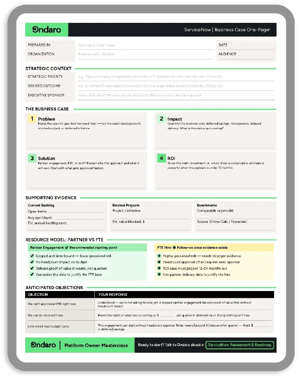
Download the one-pager
Build your business case by downloading the one-pager to guide you.