
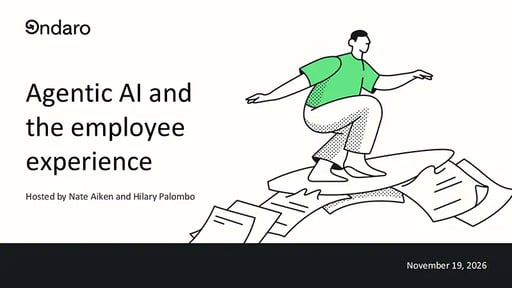
Download the PDF presentation from this EmployeeWorks Roundtable to see how ServiceNow EmployeeWorks turns a single request into finished work in your systems of record, and what to get in place before you deploy agentic AI.
Webinar
Nov 20, 2026
Exclusive Online EmployeeWorks Roundtable: The New AI Front Door to Work
Transcript
Hilary Palombo
All right, let's jump in, and hopefully people can catch up, because the first slide is really just thanking everyone for joining today. We know that you're all busy in your workday and have a lot going on, especially in Q4 and at the end of the year. So thank you all for joining.
What we've heard in the market over the past year and a half to two years is that AI is everything.
How do we get ready? How do we improve our employee experience, our IT experience, our finance experience? How do we improve the experience overall?
How do we continue to use the tools that are available and, of course, do more with less, because that's just the world we're living in today? What we're going to do today is level set with some content at the beginning.
We'll ask you to participate in the polls. We're not doing a formal poll — we're going to make it easier and not ask anybody to come off mute, unless you feel obliged; please feel free. But put questions in the chat throughout. Nate and I are going to be monitoring them, depending on who's presenting, and within the polls.
Feel free to pop your answers into the chat as well. We're going to jump right into the agenda. We'll start with a quick introduction — obviously we're already past the welcome. Then we'll go through why now, with the autonomous enterprise. Nate is going to lead us through a live demo of EmployeeWorks, and then we'll pop back out and talk about how you can measure ROI and what's happening with new releases on the ServiceNow roadmap. And of course, throughout,
please feel free to pop in those questions, and we'll leave you with a parting gift along the way. For any of you who don't know me, thank you so much for joining. I'm Hilary Palombo, senior account executive at Ondaro. I cover all of the Northeast as well as some of the energy sector, and I was previously at ServiceNow for four years in this exact division for employee experience, EmployeeWorks
and Moveworks, and I joined the Ondaro team a few months ago. What I can say is I was so impressed with Ondaro as a partner for being able to bring my customers' needs to life. There are a lot of partners out there in the ecosystem, but I found that Ondaro truly listened to each customer's needs individually, found out where their starting point was, and what they were looking to achieve.
That's why it was a really natural fit for me to join. Nate, over to you.
Nate Aiken
Awesome. Thanks, Hilary, and thanks, everybody, for joining. My name is Nate Aiken, and I'm a practice strategist for all things Moveworks and EmployeeWorks here at Ondaro. I joined the organization back in April.
I've been around the ServiceNow ecosystem for almost 14 years and in the consulting space for about 20 years now. I'm excited to be here to share some things about EmployeeWorks and how you all can get the most benefit out of it, and to help you prepare yourselves as an organization to adopt this new technology more easily.
Hilary Palombo
What would a webinar from a partner be without telling you a little bit about us? Ondaro has been in the ecosystem for about 14 years — we're coming up on it — and we're really proud because we've got about 400 practitioners at the company, North American based. We have resources in the US, Canada, Mexico and Brazil, and we've been recognized as an Elite Partner.
We're really happy about this, because it takes a lot to reach that status. Truthfully, when I was at ServiceNow, I didn't understand the true rigor our partners had to go through to reach Elite status. We have over 5,500 certifications and accreditations across our team, ten Product Line Achievements, and eight validated practices. What we see with our customers is not just a one-off project where they move on. The average lifespan for the customers we're working and partnering with
on ServiceNow is three years, and we're a pure-play partner. What that means is, yes, we have the knowledge and expertise to integrate with the systems of record, but all day, every day, we are focused on what's happening with our shared customers in the ServiceNow ecosystem. We're also really proud of our CSAT score of 4.75 out of five, because we ask every single engagement for their feedback and don't scrub any of the details.
We want to hear the great and the "hey, you could improve here," and then take that to our fulfillment teams for the next project or implementation.
As a partner, what Ondaro has seen in the ecosystem is that there are people that just do implementation, there are people that just do advisory, and then there are people you can hire for managed services or for change management.
We live across the full breadth of the ServiceNow platform — any of the major modules you can see on the green side: of course, the standards like ITSM, ITOM, HAM and SAM that live within, and then HRC, CRM.
We focus across all of these areas because we're a pure-play partner. Whenever I hear from the ServiceNow side, they all want to know: where do you specialize? What's your go-to?
Truthfully, our go-to is ServiceNow. We can share success stories across industries, across verticals and across all of these platforms. We also have practice leads in each of the major divisions, because we want people who can step into our customers' shoes, share the experience they had on the practitioner side, and bring that to life with the technology.
We can help you from the envision phase, with advisory services for getting ready: what changing business operations and modeling looks like at the beginning, and really understanding where you're starting from. Are you ready for that next deployment? Then project-specific implementation and deployment. And last but not least, what comes after the go-live.
Everyone's excited about the cake and the go-live. But following that, we want to help with adoption, change management and continued day-to-day operations — always keeping governance and risk reduction in mind throughout. Nate, anything else you wanted to add?
Nate Aiken
Yeah, the cool part is, when we talk about having coverage across the platform, you can bring us your most complex cross-workflow issues or problems you're trying to solve, and we can bring folks from each of these areas together to create cross-workflow solutions.
Hilary Palombo
And because we're going to dive into EmployeeWorks today, which falls under employee experience, I do want to share that Ondaro has done over 400 implementations
in employee experience. So while EmployeeWorks was released in February of this year, we are not new to understanding what a great UI/UX looks like and what a great employee experience looks like.
We wanted to level set, because we're here today to talk about the next generation of AI in the platform with EmployeeWorks — being that single place to go, that one-stop shop
for all of your employees to get things done and take action. But what's amazing is that AI has lived on the ServiceNow platform for the last seven years.
It started as a workflow engine, deterministic in nature, but as customers were on the platform, they wanted more. They started with Virtual Agent and natural language, which got the job done for high-volume questions, but there was a lot of setup work involved on the back end. Moving forward, there's been machine learning with Predictive Intelligence.
There's been universal search, which with EC Pro could connect to SharePoint, with the ability to bring in knowledge articles that live both inside and outside the platform. But at the end of 2024, we started to see AI come into the platform. We were looking at Now Assist on the back end for case summarization and ticket escalation, and you were able to get generated resolution notes.
And as we've all seen with ChatGPT, Claude and Perplexity, we've moved into the next generation of conversational AI, which doesn't require that setup for Virtual Agent or NLU. It uses the underlying LLM, your knowledge base articles and the reasoning engine. Which is why, instead of continuing to develop
on those tools, ServiceNow made billions of dollars of investment in Moveworks, because that reasoning engine truly changed the experience for employees.
And now here we are, moving into autonomous workflows, where agents already have personas and can take actions on the platform — of course, with guardrails in mind. Here's our first poll.
Please feel free to pop your answer into the chat — A, B, C or D. We're interested in where your organization is with adopting any of the existing AI technology on the platform.
A: Yes, we're deep into utilizing AI. B: Yes, for the most part we use AI on ServiceNow. C: Not really, but we're looking. Or D: We haven't thought about it. I'd be surprised if we get any D's — I think people are thinking about it, maybe just not taking action. I'll give it about 30 seconds for people to pop that into the chat.
Nate, I'd love to hear some of the feedback.
Nate Aiken
Yeah, absolutely. So far, no D's. We've got some B's, C's and A's, and some folks between A and B and between B and C. So I would say it's the top portion of those answers, which is cool. People are digging in.
Hilary Palombo
We're in the mix. Exciting.
Nate Aiken
Any more?
Hilary Palombo
Yeah, a little bit more.
Again, to walk through the levels of AI and where we've come from — we've all seen this is moving really fast. We went from gen AI, and everyone thought it was cool: give me a recipe, give me a summary, here's this book, tell me what's in chapters six through eight so I can go to my book club tonight and look like I read it.
Gen AI was more of a question-and-answer format, whereas conversational AI
allows you to move into a back-and-forth experience that's much more humanlike. And then agentic AI is taking action. So not only does it say, "Sure, here's your holiday time, and here's what the weather is going to be like in Florida when you go for Christmas,"
but it's going to offer, "Would you like me to book a massage for you at the Westin while you're there?"
And then it can take that action. With autonomous AI, it owns the outcomes. You have persona-based and role-based AI specialists that can resolve the issue. It could book your flight. It can book the hotel.
It can book the massage — and why not a pool cabana as well? Obviously, in the context of business, we're going to be looking at: how can you provision new software? How can you get a new mouse because it's gone through one too many airport security checks and doesn't work anymore? How can you book your time off or request T-shirts for a conference?
All of that is truly giving time back to your employees so they can get back to either serving their customers or making a true impact on the business, versus doing manual tasks.
When we're talking about EmployeeWorks today — if you haven't seen it yet, we're really excited to show you — I just want to give you some context.
Moveworks has been out there in the market. They were a conversation-first AI chatbot experience that could layer on to any system, with connectors — much like integrations or an API — into your core business systems.
What ServiceNow has always been really good at is deterministic workflows. When you bring those two together,
it allows you to keep the underpinning of all the architecture you've been developing over the years
and improve the experience at the front end for your employees. In December of 2025, ServiceNow completed the acquisition of Moveworks. By February, there was already a go-to-market product with EmployeeWorks. And in May, Otto became the branding to unify the AI that was on the ServiceNow platform, which was Now Assist, and the Moveworks experience on the front door.
So Otto is that unified brand of AI working on the ServiceNow platform, bringing these two really powerful systems together.
When we go over employee experience as a whole, I find the portal strategy and the engagement layer really important, because we're finding more and more people are working in Teams and Slack.
They already have a built-out intranet with something like Simpplr. And the reality is, with EmployeeWorks, that's great — you don't have to choose what the interface looks like. When ServiceNow first started, there was Service Portal. It's legacy, and I'll still tell you that when I ask people to show me what their ServiceNow experience is like, a lot of customers are still using Service Portal.
That's even though EC and EC Pro have been out since the Rome release, which was about four and a half years ago at this point, if we're talking about Brazil and the release schedule — we're back at the top of the alphabet. What we found with Service Portal is that it was very heavily dictated by search and tickets via forms.
It was a little more rigid, and there were people building out workflows under Service Portal. But moving into Employee Center or Employee Center Pro, it truly became personalized. It allowed you to have those integrations underneath and
provide communications personalized to your employees. It gave you broad universal search, which could connect into SharePoint or another system where you're keeping your knowledge articles.
And it was configurable, so you could have microsites for different departments. But I always make the joke — and I'm sorry if you've seen me do this presentation before — that it was like, you get a portal, and you get a portal, and you get a portal. But what does that do to your employees?
That's still what we're seeing across the board: when HR is making a decision about how people get support, and IT is making a decision, and finance is making a decision, people get lost and frustrated, because they just want to get the task completed so they can get back to their day-to-day work.
This is really where the EmployeeWorks web app — formerly Slate, formerly Moveworks on top of EC Pro — comes in. This is the new interface that's been released to be conversational first, with outcomes in one interface. Much like Moveworks could interact or engage at any level, the same is true for EmployeeWorks. All the connectors into your systems of record are included with EmployeeWorks.
Whether you're running Oracle, SAP or whatever your major ERP system is, or Ariba for procurement, or ServiceNow, it will have the connectors so your employees don't have to leave their preferred channel. I'm going to share one story because I think it's pretty cool. A major bank in Canada decided to name their EmployeeWorks experience Nina, so that when employees asked a question, people would say, "I don't know — go ask Nina."
They made a huge brand campaign around Nina. They had a logo created for "Who's Nina?" and put it out throughout the bank for their employees — incredible change management. And because it worked so well, adoption grew. With that particular bank, the service desk manager is looking — by the end of this year, and I'll be really excited for the reporting —
to have 90% deflection and eliminate the tier-one service desk. They're not eliminating jobs; they've enabled those people to continue to develop on the platform and the experience, as well as continue to monitor and set up guardrails. It's amazing, because instead of those IT professionals answering routine questions over and over again, they're now developing new skills for their careers as well.
Nate, I am going to pass it over to you.
Nate Aiken
Thanks, Hilary. Good stuff there. Like Hilary said, this is all developing really quickly, and what we're seeing is that the technology is ready before most organizations are. There are a number of areas we see that really decide whether these agentic technologies hold up in production. The first is content.
Think about your knowledge and your catalog, and any pain points you have today. If you're reading a knowledge article, does it answer the question you're looking for, or does it push you off somewhere else?
When we look at how AI reads and parses knowledge, it does it in chunks. So if I go in and ask, "What is the PTO policy?" and the knowledge article says, "Go over here and read this Word document or this PDF we've put together," that's not very helpful for AI. AI can't parse that out of the attachment.
You want your knowledge articles to answer questions directly and concisely. That way, when you use the EmployeeWorks web app with Otto to ask those questions, it's able to retrieve the answers and provide those insights directly.
Same with your catalog items. Think about catalog items that are highly complex. I've built so many catalog items in my career that it got to the point where I didn't even like testing them, because some were so complex that testing every possible scenario would take days.
So you want to think about your catalog items and collecting what's needed to truly fulfill the request for the employee in the simplest way possible. That will also help when you start to ingest or process those catalog items with AI and have them submitted on the user's behalf, so it's able to do so efficiently.
The second area is data and integrations. Hilary talked about some of the connectors that are available for Moveworks and EmployeeWorks. Moveworks has over 150 connectors available in their marketplace, which is kind of like the ServiceNow Store.
You can go out there and browse that catalog. There are the connectors, and there are use cases or scenarios beneath those that help you integrate with all the various platforms you might have in your organization.
When we get to the demo later, I've got it connected to Concur and a Workday system, so we can see some integration actions occur simply in a conversational interface. A lot of those connectors are prebuilt — you configure them, set them up, and you're able to make clean integrations. You want the systems you connect to to be trusted.
So if you're thinking about your Workday environment today and it's like, "Man, our employee records are not very good," or you look at Concur and it's like, "Yeah, we have some problems there," you ideally want to get those systems into a state where they're trusted and accurate, and you can rely on the data. AI is not going to fix that for you. It's only going to surface those problems and make them more visible.
The third part is governance: clear rules about what AI is able to do and where it has to stop and hand off to a human. One example might be a process that cuts a check at the end and puts it in the mail. Somebody should probably review that and make sure that instead of a $1,000 check, it didn't cut a $1 million check.
Anything you would consider high risk in your organization, or that could be detrimental to the organization, is an opportunity for governance.
And the last one is adoption. Hilary talked about that a little bit. If our first experience using EmployeeWorks is not great — if all of the other things above this are not in line and our first experience is horrible, we get incorrect answers, it points us to the wrong place, orders the wrong things or whatever —
I'm probably not going to go back and use it. So we want to make sure we have a solid foundation, so that when users come in and have that first experience, it's an exciting one for them — something they enjoy, something that makes their life easier.
Otherwise, they're going to go back and want to use the forms in EC Pro and not use the new AI technology we've now implemented and spent all this investment developing and implementing.
Hilary Palombo
Yeah, and I'm sure you can all think of a time when you tried to use a chatbot and it wasn't great. I always go back to the story of Avianca Airlines. Whoever has them as a prospect customer, go to them, because it would be amazing to
help solve it. There was a jailbreak in Ecuador, and I needed to change my flight and get out sooner.
It took me into WhatsApp and just kept giving me generic answers, asking, "Are you satisfied?" I'm like, "No, my life is on the line. I'm not satisfied." Versus with WestJet or Delta, when a flight has been canceled, it was very easy for me to communicate and get some options for what the next flight could look like.
I'm sure you can all tell me about experiences you've had with chatbots, but I think Amazon is another great example of how easy it is to get a resolution. That's really what we're looking for for all of your employees inside the organization: having that conversational experience, feeling understood in what the request is because of the Moveworks reasoning engine, and then getting it done and being able to move on with peace.
Nate Aiken
Absolutely. Second poll here: what area do you feel would be the greatest challenge for your organization? Do you think it's the content, the integrations with those other systems you have to rely on, governance or adoption? If you can, put your answers into the chat.
All right, we have data and integrations. Oh, A, B and C. All of the above. B. A, B and C. Yeah, it usually is a combination of all of the above. And I would say A and B are typically a consequence of C. Lack of governance usually leads to bad data, integrations and content. So building that foundation is important.
We're going to jump into a demo. I'm going to share my screen, and we'll show the EmployeeWorks web app. We'll go through a live demo here.
Hilary Palombo
You're up, Nate.
Nate Aiken
Hopefully everyone can see my screen. What we're looking at here is the EmployeeWorks web app, formerly known as Slate. As you can see, it's kind of a familiar interface. It looks like ChatGPT or Claude. You have a text box where I can ask questions, get answers and work with Otto to get what I need done.
Right beneath that are configurable quick prompts. I've prepopulated some common types of requests that users come in and ask for. You can configure these uniquely for your organization.
Below these are administrator-configured widgets. We've got a communications widget and a list of tasks. You can see I'm an absolutely horrible employee — I haven't completed my Q3 security awareness training yet, and we're well into Q4. I'd better get on that.
But I can click into these and mark them complete when I'm done, then come back out to the main page.
There are things like popular content. This is a combination of request items — catalog items — and knowledge articles. This widget is configurable. You can put links in it. You can surface your password reset, in this case. You can bring forward admin-configurable hot items that you want to feature right on the front page. This is all configurable. We'll come back to that in just a few minutes.
Then there's the canvas. The canvas is an employee-personalized area. As an employee, I can come in here and lay it out in a way that suits my needs. Right now, I've got a team widget and tasks, and I can see my requests. I've got a blank space up here — let's fill that. As an employee, I can come in here and rearrange this layout how I see fit.
I can add to the canvas. These are widgets that have been made available to me as an employee. Maybe I want to see all the latest KB articles when I come in here — these are all the newly published articles. If I save that, it keeps it, so next time I come back into the canvas, it's going to be laid out exactly the way I want it, personalized.
Hilary Palombo
And Nate, I love this part, because what typically resonates with people is to think about your iPhone screen or your Galaxy screen — nobody's looks exactly the same. At the enterprise level, everyone has always said, "We want to create the best portal," or "the portal that's going to please everyone." The challenge is that people are so unique that they want to see what they want to see —
what's important to them. That's where canvas comes in. It truly is personalization at the individual level versus by employee type.
Nate Aiken
Absolutely. Right now, these are all out-of-box widgets. This is a whole new technology stack. If we look back at the slide Hilary showed with the three columns,
the technology stack this is built on is AI UX with Lit.js, so it's slightly different than the previous portal technologies. Coding or developing new widgets is a little bit different. You can't bring your widgets forward from EC Pro into the EmployeeWorks web app, but you can develop new ones that do all of the same functionality, and Ondaro has folks who have already begun doing that.
That's something to think about going forward in terms of your migration. If you're looking to go from Employee Center or Employee Center Pro — or maybe even from Service Portal — into this interface and you have custom widgets, you're potentially looking at some redevelopment work, depending on what those are, if there's not something out of box that suits your needs.
Hilary Palombo
And one other option, because we've said EmployeeWorks can be accessible anywhere: if you have a really great EC Pro experience that's been built out and your employees really like it, you have the ability to layer the conversational AI on top of your EC Pro portal. You'll have that experience — you're just not going to get what you're seeing here today, which is canvas, nor what it looks like from Slate.
But you do have the ability to embed the EmployeeWorks conversational AI in any of your existing portals, or allow employees to engage with it through Teams, Slack or another method of choice. I heard someone else say Haiku — I feel like that's used in the medical space. So it can live anywhere your employees are engaging. We want them to be able to stay in the channel of their choice.
Nate Aiken
Absolutely, and that's actually a good point, Hilary. Going a route like that gives you a way to transition into something like this without completely eliminating the EC Pro implementation you have today.
You might start out by taking the conversational interface — the conversational chat — and bringing it into EC Pro, getting folks used to the reasoning engine behind EmployeeWorks and using Moveworks to get the answers and take the actions they need, and then evolve into the full Slate interface.
I'm going to jump through just a couple more pieces here and quickly click through these. This is tasks and requests. There are a ton of different ways to render some of this.
I don't have a good org chart relationship set up here, but with a proper import of your employee data with the proper relationships, it will render a really nice org chart.
In some of the recent releases, ServiceNow has brought more of the point-and-click experience into this interface. You can browse requests and articles from your knowledge base, just like you would in the portal. I could come in here, browse and see what's available to me as an employee without having any sort of conversational chat.
Now I'll get into the fun stuff. We want to see this thing really work.
Hilary Palombo
We have one question in the chat: for canvas, can you bring in your favorite catalog requests?
If you have great catalog requests — I know when I was at ServiceNow, my favorite catalog request was the request to travel for customers. That was absolutely one of my favorited catalog types.
Nate Aiken
I see that question a couple of different ways. I could surface it in something like this popular content, or have a widget I select on my canvas so I always have a link directly to that catalog item.
Ideally — I don't have it set up in this environment; I don't have any travel requests here — but what if I could just come in and say, "Hey, I need to book a trip in a couple of weeks to this meeting in Vegas, from these dates to these dates," and it does it for me? That's the ultimate goal.
There are a couple of different ways you could do that. Yes, you could definitely bring in your favorite catalog requests. That's kind of what this one is — this is based on view counts.
First, I'm just going to use one of these quick prompts. As an employee, maybe I didn't see my last pay statement. I can just give it a prompt that I want to check my last pay statement.
You can see that it's going out and looking at Workday. It came back and presented a quick summary of my last paycheck. Obviously, this is all demo data — unfortunately, it's not real. I could have it cut me another one; that would be nice. So just a real quick example: this is a simple integration out to Workday. It was able to go out in just a couple of seconds, get the answer I needed and bring it back to me without having to swivel-chair between systems.
I didn't get an answer that says, "Go check Workday. Here's a link. Go log in to Workday, click around, find the answer and then come back." I just asked a simple question, and in four seconds it came back and gave me my answer without leaving ServiceNow.
Hilary Palombo
As you can see, Nate has customized it to say "Assistant." This is really that Otto experience. And as I mentioned, the bank branded theirs Nina. So although the go-to-market name from ServiceNow is Otto, you can name the assistant, brand it and create an avatar to really help with change management and adoption.
Nate Aiken
Absolutely. I'm going to give it something a little more complex. I could just ask it, "Hey, I want to take some time off," but that's too simple. I'm going to give it a multistep task here.
"I want to take next Friday off. What is the PTO policy? And do I have enough time off to do that?" So there are three parts to what I'm asking. I'm telling it I want to take next Friday off — that's a PTO request. I'm asking what the PTO policy is, so it needs to go find that. And it needs to determine if I have enough time off.
So it's doing this in multiple steps. It was attempting to do multiple steps here — I'm going to submit that request again. We'll do this again. All right, here we go, that one worked. So again, we have our three-part request to the assistant.
It went out and got my PTO balance. It says, "Yep, you've got enough time off," and gave me my balance — that came from Workday. Then the PTO policy summary: this is actually a ServiceNow knowledge article. It summarized it for me and tells me what the PTO policy is. The nice thing about EmployeeWorks is that it will actually give you citations.
Everything it's telling you here is grounded in truth, based on something real that I have access to. That's one of the greatest powers of using the Moveworks engine to power EmployeeWorks: it has an understanding of what my role is, who I am, what country I'm in and what department I'm in.
It will surface information that's relevant to me, but also that I have permission to see. If you have user criteria set up on your knowledge bases or catalog items, all of that is honored through Moveworks — it has context and understanding of all that. If there's something I don't have access to, the Moveworks engine is not going to surface it for me as an employee.
Okay, we have our summary. It says we could go review it, or "I can help you submit that request for next Friday." Yeah, let's submit that request. Now it's going to determine what tools it needs to submit that request, and we can always see what it's doing.
It's setting up a Workday PTO request for me. This is not going to be a request we see in ServiceNow — this is communicating directly from the Moveworks engine to Workday. So there won't be any requested item or request record in ServiceNow for this. Do we want to add a note?
"I'm going fishing."
Great. It determined that a note was possibly needed, and now it's confirming: next Friday, 11/27 — I think that's right — I'm taking a vacation day for one day with the note "I'm going fishing." Let's go ahead and submit that request.
And it's done. I don't need to go over into Workday and do anything. It did it all for me. From a single conversational interface, I was able to get all the answers I needed from ServiceNow and Workday combined into one conversation and get that request submitted, which is pretty cool. That's where we go beyond generative AI into autonomous action — it's taking ownership and completing that request for me.
One of the other great things — and we'll cover this when I talk about a couple of key roadmap items coming as part of the EmployeeWorks roadmap.
I'm just going to say, "I need a new MacBook Pro power adapter." I've been traveling a lot. It's been in a lot of hotels, and I've dropped it a few times.
With this particular request, it's going to take a look. It's spinning up the process to order a new power adapter. Now that I've set up this particular request, you'll notice it's not giving me a form. It's not asking me to fill out a bunch of things.
This one's a fairly simple request. I can just say, "Yep, I need a new power adapter," and it's going to go out. Here's my request number — it's been submitted for me. I didn't have to fill out a form. I didn't have to do anything.
For some of your more complex items — maybe I need a whole new laptop — one of the great things about using the EmployeeWorks web app is that it can render your catalog items and knowledge articles inline.
I said I need a new laptop. It went out to the catalog and found all of the items available to me. I need a new developer laptop. It now has the ability to render your entire catalog item form right here in the EmployeeWorks web app. I could potentially automate this so it's conversational, but I wanted to show the ability to do this.
This honors all of your client scripts and workflow rules — everything behind it. There are some limitations with how you integrate with some things, like Teams. We've had some customers that wanted to use Teams for this conversational interface. Moveworks integrates with Slack, Teams or whatever chat or collaboration platform you might be using. Teams has a bit of a limitation: it doesn't honor client scripts. That's something to think about going forward.
But it can render and complete a more complex item in the traditional manner you might see.
I have one more. Let's see — "I have a team dinner receipt that I need to submit an expense for." This is a much better one. This is going to be an integration with Concur. All I'm telling it is that I have a dinner receipt. I'm not giving it any details about what it is.
It's going to determine what tools it needs. We can see — let's say, "This is the sales team dinner." Great. Okay.
Hilary Palombo
They aren't going to like that one, right?
Nate Aiken
It's not — it's not thorough enough.
Hilary Palombo
I just meant based on a sales team going out to dinner.
Nate Aiken
Oh, okay. I just have a JPEG image of a receipt. I'm going to upload that receipt. We can see it's just a receipt photographed on the table — it's about $365. It's nothing fancy; it's not a proper scan. I'm going to go ahead and submit that receipt.
All right, it uploaded. It's now going to process that receipt. What do I want to name the expense report? I'm just going to say this is my October expenses. The receipt date on that was October 30th, so I've got to get those in.
It's now processing that receipt. We gave it an image. I didn't tell it how much it was, what credit card I used or any of that.
We can click in and see where it is. All right, it actually parsed it out: Desert Sage Bistro, $365.39. Confirm expense creation? Sure. And off it goes to send that and upload the receipt, and I now have a link directly to my report. Pretty simple and pretty cool. I didn't have to go into Concur, create a report, put all the things in and upload the receipt. I just had a quick conversation with the assistant, Otto, in the EmployeeWorks web app, and it was able to submit my expense for me.
We've shown a couple of different enterprise systems here. Think of some of the other use cases you have in your organization where you could potentially build out the integration. We can help you build out integrations to some of those systems and solve use cases that might make life easier if you could do them through conversation rather than point and click.
I just wanted to talk a little bit about measuring the improvement of an autonomous experience. There are two axes we see that you can measure. One is productivity: how much more efficient is your organization? How much more efficient are your employees by having an experience like this?
Look at the number of requests resolved without a human. How fast are you able to resolve these? No one had to go review that request, provide anything or resolve anything.
How many service desk and HR hours are returned to more productive things? Hilary talked about the entire service desk being retrained or trained up to develop and continuously improve a system like this — reducing your cost per request.
Your organization may have some other ideas or KPIs you're looking to achieve with this. Going into a project like this, you want to measure the current values for those KPIs and record them. Then, as you go through a project to implement something like this, look at the improvement you're seeing for the organization on the back side of the project. That will help you justify the investment made in tools like this.
The second axis is really around satisfaction: how much happier employees are with the process and the interaction of getting things done. If I could go in and have this same experience every day for everything I do — man, that would be amazing.
I use Claude quite a bit, but being able to submit a time-off request or find all the answers I need through a chat like that and have it summarized for me real quick would make my life a heck of a lot easier. Just some things to think about.
What is the adoption rate? How many of your employees are using and repeatedly using a tool like this, so they're coming back to it and not just using it once and walking away? Does it resolve requests in one ask? How many times have they had to come back and ask for the same thing over and over?
Think of the days of calling the help desk: "I called today, it's not fixed. I'll call back tomorrow. Can we get this done? I need to work." If we can get it done in one ask, that's awesome. Think about some of the processes or workflows you could automate on the back end — there's room for improvement there. And the last one is really about reducing escalation and abandonment.
Hilary Palombo
Should I move forward, or do you want me to go back one?
Nate Aiken
No, no — we can move forward. So, the abandoned conversation. There are things you can measure along the way, and there are metrics and reporting available to help measure some of that.
The survey question here is: does your organization have KPIs defined today that would help measure some of these outcomes? You may have KPIs that are more aligned to some of the manual tasks, or the manual ways of doing things today, that can be shifted or adapted for autonomous AI. I'd love to see what your answers are here.
Hilary Palombo
Yeah, I'm interested, because in standard ITIL you obviously want to set service level agreements. But if we're talking about HR, legal, procurement or finance, typically they're not working within that same framework. So I'm interested to hear by organization and also by the business units inside.
Nate Aiken
We got a couple of answers there. Both are B. All right, I would say that's probably where I'd expect most people to be. If you didn't have any KPIs, I would be concerned. Having some and seeing that you have room for improvement is always good — we're in the business of continuous improvement. I think I just have a couple more slides here.
I wanted to talk a little bit about some of the things that are coming. We've talked a little about what's available today. Everything I've shown in this demo is available today.
Hilary Palombo
Safe harbor. So I better be right, Nate?
Nate Aiken
The next couple of slides, I will say, do fall under safe harbor. Some of this may be partially released or on the future roadmap, and dates may change. So don't make any purchasing or investment decisions based on the next couple of slides.
Like I mentioned, I just wanted to point out a couple of the key features I see coming as part of the ServiceNow roadmap for EmployeeWorks that are really game-changing.
First is the EmployeeWorks productivity assistants. As part of using the Moveworks engine to power EmployeeWorks, they are building out a number of productivity assistants. Think of things like the hiring assistant agent, and there's a talent intelligence assistant agent. There's a wide variety, and those are just a couple of the HR ones.
They're coming out with basically an assistant store, and in that store there will be shareable templates for AI agents. You'll also have an assistant builder — a no-code setup where you'll be able to build custom agents to help you complete tasks autonomously across the platform.
And the next one: I showed the MacBook Pro power adapter. Right now, to do a no-touch conversational catalog item, there are a few steps involved on the back end to make that work, so the agent knows what questions and slots it needs to fill, maybe some data lookups and things like that.
ServiceNow is coming out with a catalog interpreter. In the example on the right, at the top you have your desk change request. It's going to have a bunch of questions you need to answer. At the bottom is the interpreter — it's a little hard to read, but I can summarize it.
Basically, the user says, "Hey, I have this table of employees that need to change desks. Go into Notion, grab this table, feed it in and process a desk change request for these folks."
What the catalog interpreter will be able to do is take your existing catalog items — honoring all of the UI policies, client scripts, mandatory fields and such — and create that conversational experience for each of the catalog items.
So with the developer laptop I showed, the catalog interpreter would be able to take that and, in a couple of clicks and some testing, convert it into that conversational experience for me. They're trying to simplify the process of taking your items and making them conversation-ready. Right now, it's a little bit more manual.
Hilary Palombo
We're almost at the top of the hour, Nate. So with this —
Yeah, we wanted to provide a takeaway for everyone. Thank you all for spending the beginning of your afternoon — or perhaps the middle of your day, depending on where you're joining from. We're offering something called AI Lighthouse. It's a complimentary 90-minute assessment to see how ready you are to move forward with EmployeeWorks with your existing configuration of the platform.
We will do this all for you for free. If you attended today, one of our agents will also reach out to you as a follow-up to get this time scheduled, if you're not already registering with that QR code. Are there any other questions you see in the chat before we release everybody back into the wild?
Nate Aiken
I have a few more minutes if there are any questions. If anybody wants to come off mute and ask a question, or put your question in the chat, I'm happy to take a couple. But if you have to drop, I completely understand. I appreciate your time and look forward to future conversations.
Hilary Palombo
Thank you guys so much, and have a great rest of your day.
Exclusive Online EmployeeWorks Roundtable: The New AI Front Door to Work
Your employees shouldn’t have to know which system handles PTO, which portal resets access, or who approves what. In this online roundtable, Nate Aiken, Practice Strategy Lead for Moveworks at Ondaro, shows how ServiceNow EmployeeWorks brings workflow automation together with the Moveworks AI Assistant platform, so one conversation becomes completed work across IT, HR, Finance, and Facilities. He walks through a live demo with visible guardrails, a framework for measuring value, the ServiceNow roadmap, and the four readiness areas that decide whether agentic AI holds up in production.
Meet the Speakers
Nate Aiken
Practice Strategy Lead for MoveWorks, Ondaro
 Nate designs and implements customer focused service management solutions that improve operational efficiency through proven processes and the right technology fit. Nate brings close to two decades of ServiceNow and IT service management experience to the role. At Ondaro, he leads in helping clients prepare for EmployeeWorks, aligning data, workflows, and experience design so organizations can adopt AI powered employee experience tools on a foundation of clean data and clear governance, rather than as an afterthought.
Hilary Palombo
Senior Account Executive, Ondaro
 Hilary worked at ServiceNow over all of North America for the last four years ranging from retail and hospitality customers to public sector, energy, healthcare and financial services. She has worked with organizations going through business and organizational transformation with technology as an afterthought as well as showcasing hard cost savings from technology investments. Hilary joined Ondaro after witnessing the truly incredible work performed for her customers while at ServiceNow. In her spare time, you will most likely find her at a country music concert singing along loudly
We're with you for what comes next
You're working in a rapidly shifting environment.
Global dynamics, AI advancements, heavy competition–the only certainty is change.
We get it. And we're here to help you harness the full potential of ServiceNow to simplify transformation.
Let's navigate the future together.
Recommended Articles
View all
ITAM
Webinar
Webinar
Platform Owner